
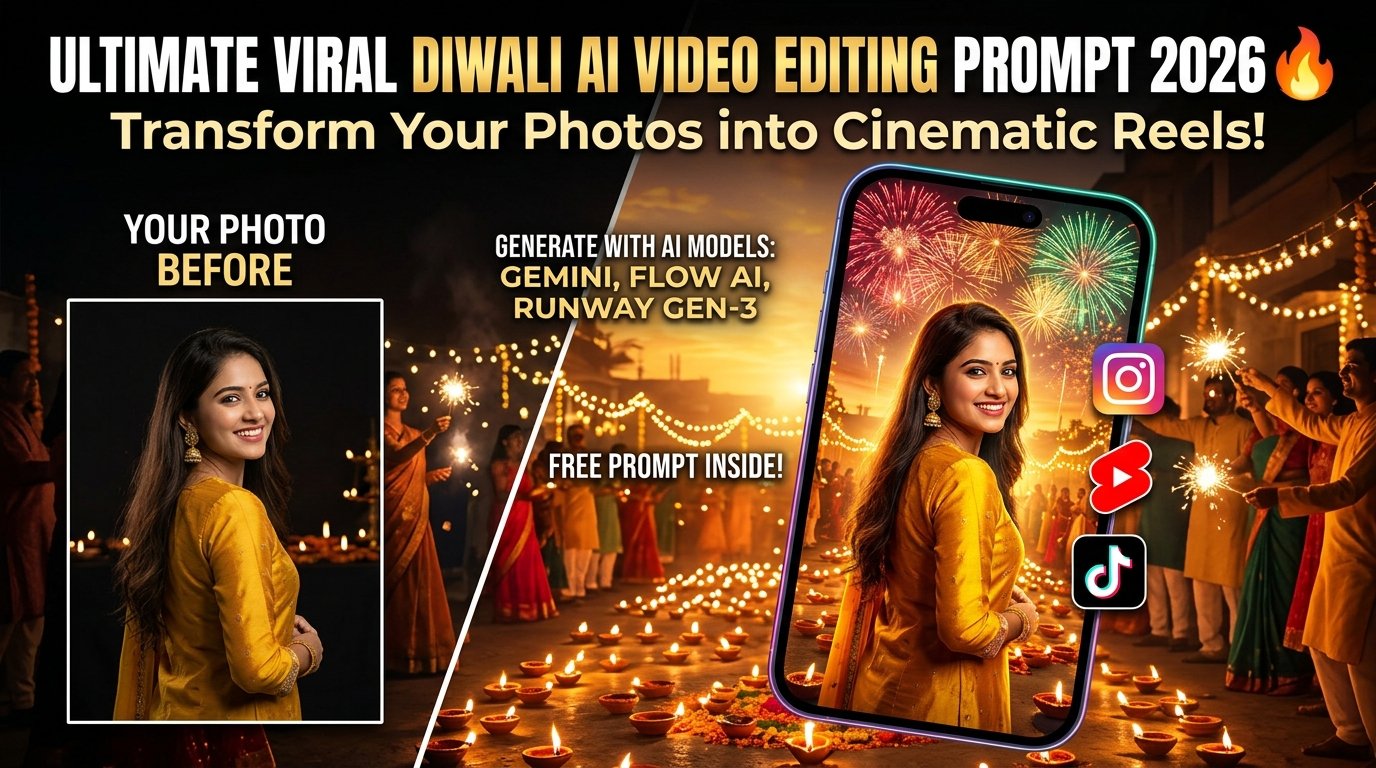
Celebrate the Festival of Lights like never before. As social media feeds light up with stunning festive content during Diwali, standing out on Instagram Reels, YouTube Shorts, and TikTok requires more than standard filters. With advanced generative AI video models (such as Google Gemini, Flow AI, and Runway Gen-3), you can seamlessly convert an ordinary portrait into a breathtaking, high-definition cinematic masterpiece.
This comprehensive guide covers everything you need to craft viral Diwali AI videos, complete with professional prompt engineering, tool workflows, and expert optimization tips.
Featured Visual Assets & AI Image Generation Prompts
To give your website a polished, high-end look, use the following prompts in Midjourney, DALL-E 3, or Stable Diffusion to generate your featured article images and thumbnails:
1. Hero / Thumbnail Image Prompt (Matching the Style of Your Competitor)
Prompt: A vibrant, ultra-realistic vertical thumbnail image (9:16 aspect ratio) for a viral Diwali video editing guide. On the left, a smiling young woman with traditional long hair and exquisite gold earrings wears a radiant yellow and mustard ethnic silk kurta, looking back over her shoulder with a joyful expression. The background explodes in a magnificent, glowing display of warm golden twilight, hundreds of flickering terracotta diyas on the ground, soft string fairy lights, and grand, colorful firework bursts illuminating the sky in ruby red, gold, and emerald green. Cinematic lighting, rich color grading, photorealistic, 4k resolution.
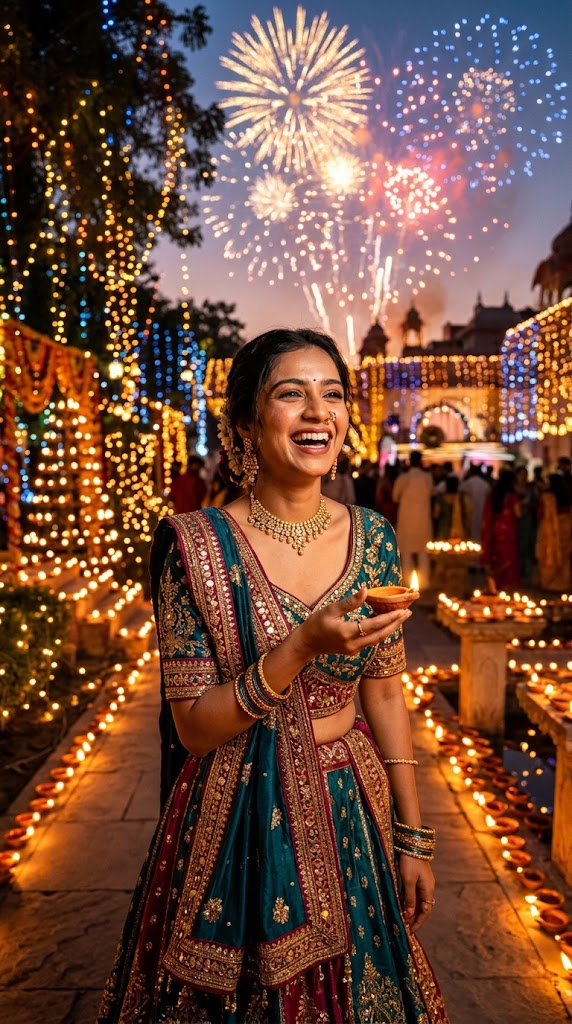
2. Secondary Context Image Prompt (Visual Reference Scene)
Prompt: A stunning cinematic mid-shot of a person standing outdoors during a festive Diwali celebration at dusk. Surrounded by a warm, soft-focus sea of glowing clay diyas and fairy light bokeh. In the background sky, giant festive fireworks bloom with colorful light particles reflecting off a smiling face. Hyper-detailed textures, professional color grading, warm ambient glow, vertical 9:16 format.
Why AI Diwali Video Editing is Trending in 2026
Traditional video editing demands hours of masking, color grading, particle effect integration, and After Effects keyframing. Today, Image-to-Video AI pipelines analyze facial structures, lighting angles, and wardrobe attributes from a reference photo, projecting your likeness into a dynamic celebration scene complete with flickering diyas, volumetric golden hour glow, and reactive fireworks.
Interactive AI Prompt Workspace
Use the tool below to instantly grab the master-crafted, ultra-detailed Diwali AI video prompt. Click the “Copy Prompt” button to copy it straight to your clipboard.
Cinematic 9:16 vertical video. Seamless image-to-video transformation based on the uploaded reference photo. A joyful individual in a vibrant traditional Indian festive outfit (rich silk ethnic wear with subtle gold embroidery) standing outdoors during a warm twilight celebration. The background features a stunning display of hundreds of glowing terracotta diyas, soft ambient bokeh lighting, and sweeping cascades of colorful fairy lights. Real-time cinematic lighting where warm candle flicker plays dynamically across facial features. In the background sky, grand, colorful fireworks burst in slow motion with rich particle sparks (gold, ruby red, emerald green). Smooth, slow panning camera movement, highly realistic skin texture, sharp focus, 4k resolution, rich color grading, natural motion physics.
Step-by-Step Workflow: How to Generate Your Video
Method 1: Using Google Gemini / Advanced Multimodal Video Engines
- Access the Platform: Open the official Google Gemini application or web workspace and sign in.
- Upload Your Base Image: Select a sharp, high-resolution portrait with clear facial lighting and upload it as your reference asset.
- Deploy the Prompt: Copy the master prompt from the interactive widget above, paste it into the generation dialogue box, and execute the request.
- Render & Download: Review the synthesized video file, ensuring facial consistency and smooth particle rendering, then download it directly to your mobile or desktop device.
Method 2: Using Flow AI or Dedicated Image-to-Video Tools
- Open Flow AI or your preferred video generation suite and initiate a new project.
- Select the Image-to-Video mode and upload your chosen character reference image.
- Paste the prompt into the control text area, verifying that your aspect ratio is locked to 9:16 Vertical for optimal mobile viewing.
- Click Generate, wait for the neural network to process temporal frames, and export your final reel.
Pro Tips for Maximum Realism and Engagement
- Reference Image Quality: Always feed the AI a high-contrast, front-facing portrait with natural lighting. Blurry photos lead to distorted facial morphing during video generation.
- Avoid Over-Complexity: Do not cram too many rapid actions into a single prompt. Keeping the focus on ambient lighting, subtle smiles, head tilts, and background fireworks yields cleaner AI outputs.
- Post-Processing Audio & Polish: Import your downloaded video into CapCut, VN, or Instagram Reels Editor. Layer traditional instrumental fusion beats or viral celebratory trending audio, and add clean, styled captions to maximize viewer retention.
Frequently Asked Questions (FAQs)
Q1: Do I need professional video editing skills to use this prompt?
Answer: Not at all. The entire point of AI video prompting is to bypass manual keyframing and color grading. The AI handles the motion physics, lighting sync, and background effects automatically based on your text prompt and photo.
Q2: What is the ideal aspect ratio for social media platforms?
Answer: For Instagram Reels, YouTube Shorts, and TikTok, always configure your output setting to 9:16 Vertical to fill mobile screens completely.
Q3: Why does the AI change facial features slightly?
Answer: Some generation models interpolate character likeness loosely. To minimize this, use a clear reference photo and ensure your prompt emphasizes facial preservation. If the first output fluctuates, re-run the generation or adjust your seed parameter.
Ready for the next one? Send over your next competitor article or PDF whenever you want!